The Caduceus

A Symbol of Healing, Harmony, and Hermetic Wisdom
In the quiet corners of our collective consciousness, symbols reside, evoking profound meanings that traverse cultures and time. As someone who enjoys the transformational process of creativity, I've often found myself intrigued by such symbols. One symbol that has fascinated me and many others for centuries is the Caduceus.
Understanding the Caduceus
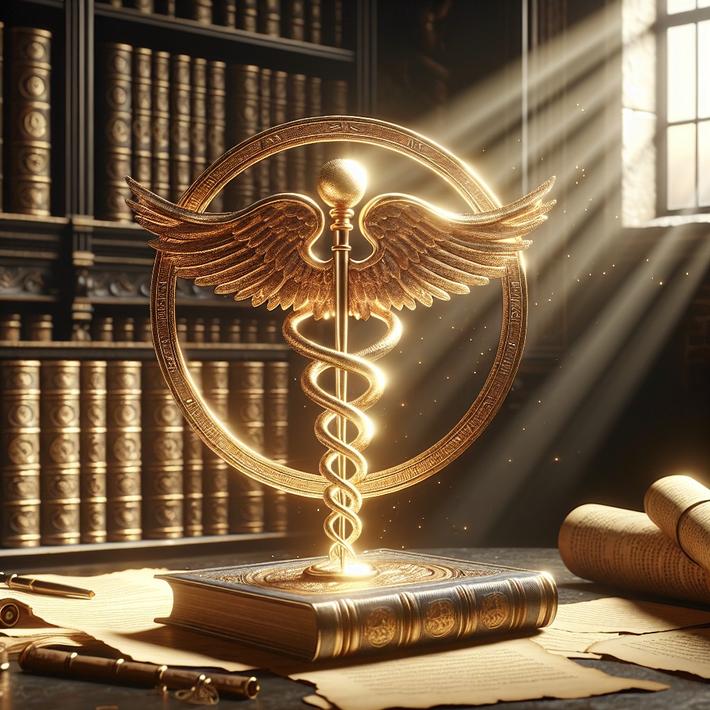
The Caduceus is more than just an emblem from Greek mythology; it is a deeply layered archetype whose meaning has evolved across cultures and through inner exploration. Traditionally associated with Hermes, the messenger of the gods, the guide of souls, and the patron of boundaries and transitions, the Caduceus represents movement between worlds, realms, and states of consciousness.
Its structure—a staff entwined by two serpents and crowned with wings is an exquisite geometric composition. Esoterically, the central rod symbolizes the axis mundi or world axis, the spine of the world, and the self. The serpents represent dual forces, light and shadow, masculine and feminine, sun and moon, Ida and Pingala coiling in harmonic opposition and weaving balance through motion.
The Tale of Tiresias
One intriguing tale associated with the Caduceus is the story of Tiresias. This figure in Greek mythology was transformed into a woman after he separated two copulating serpents with a staff. Seven years later, he repeated the act and was transformed back into a man. This myth illustrates the symbolic power of the staff and serpents as instruments of transformation, crossing boundaries of gender, form, and perception. In many ways, it reflects the alchemical union of opposites—an essential principle in Hermetic thought.
Geometry, Energy, and the Human Body
Geometrically, the Caduceus mirrors the double helix structure of DNA, suggesting that this symbol encodes the very blueprint of life and transformation. It also mirrors the chakra system in Eastern traditions. The central rod is analogous to the human spine. At the same time, the serpents correspond to the dual energy channels Ida and Pingala, which spiral upward and intersect at energy centers known as chakras.
At the base of the spine lies the dormant energy known as Kundalini. In yogic philosophy, when awakened, this energy rises like a serpent, moving through the chakras to reach the crown of the head, resulting in spiritual awakening or enlightenment. The wings at the top of the Caduceus symbolize this awakened state, expanded awareness, divine insight, and union with the cosmos. The entire symbol thus becomes a mystical map of human transformation, illustrating the ascent of consciousness from material to divine.
The Caduceus and Healing
In modern times, the Caduceus has been adopted as a symbol of medicine and healing, though often confused with the Rod of Asclepius. While the Rod of Asclepius has a singular serpent and no wings, the Caduceus, with its dual serpents and wings, speaks to a broader vision of healing, one that includes psychological integration, spiritual awakening, and balance of opposites within the self.
"Symbols, in my view, are the natural language of the soul, a bridge connecting our inner and outer worlds. The Caduceus, with its twin serpents and winged staff, speaks to our innate yearning for healing, transformation, and balance."
Transformation and Inner Alchemy
To work with the Caduceus as a symbol is to enter the realm of inner alchemy. Just as the alchemists sought to transmute base metals into gold, the spiritual seeker seeks to transform dense, unconscious energies into awareness and wholeness. The serpents represent this process confronting duality, moving through trials, and emerging integrated and illuminated. The staff is the channel, the path, the sacred spine through which life force flows.
In Hermetic teachings, the phrase "As above, so below" reminds us that the macrocosm and microcosm mirror one another. The Caduceus illustrates this harmony—physical healing and spiritual ascension are not separate pursuits but interwoven currents of the same stream.
References and Resources
For those interested in delving deeper into the meaning and history of the Caduceus, I recommend reading Carl Jung's Man and His Symbols, The Secret Teachings of All Ages by Manly P. Hall, and Kundalini: The Evolutionary Energy in Man by Gopi Krishna. These works explore the symbolic language of the soul and the mystical anatomy of transformation.
Final Reflections
As I reflect on my journey with the Caduceus, I am struck by how symbols can contain entire cosmologies, philosophies, and instructions for living. I don't subscribe to the religious or spiritual anecdotes this symbol represents, but I appreciate the human journey toward enlightenment and transformation. I believe that symbols are essential for communication and for providing a broader understanding of knowledge. Like mythological stories, symbolic imagery is often an effective way to illustrate archetypes with deep meaning. Much like the gods and demigods of old, they are not to be worshiped.
So, what symbols resonate with you? And how do they shape your understanding of the world? As we continue to navigate the complexities of life, may we always find wisdom and guidance in the rich tapestry of symbols that surround us.